BHUTAN BACCALAUREATE
Creating Constructive Contributory Citizens of a Just and Harmonious Society
HISTORY OF THE BHUTAN BACCALAUREATE
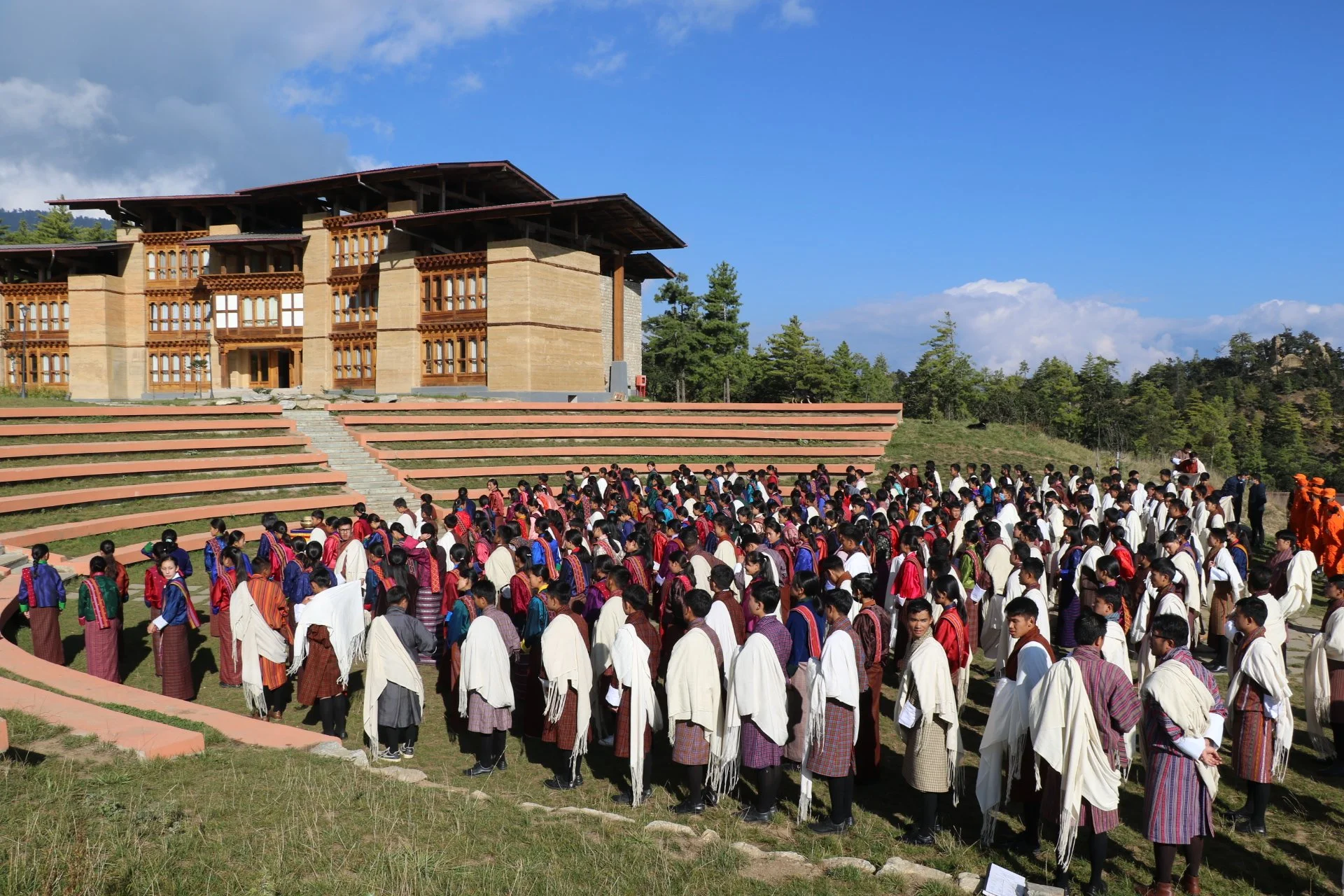
The inception of the Bhutan Baccalaureate is intertwined with the establishment of The Royal Academy, which dates back to December 2010. A survey on the question “What do you want your children to learn”, conducted in May 2011 gathered perspectives from various segments of Bhutanese society from across the country about their educational aspirations. The survey findings significantly influenced the basis of philosophy and curriculum of the Bhutan Baccalaureate. To read more on the History of the Bhutan Baccalaureate, click the button below.
PHILOSOPHICAL UNDERPINNINGS
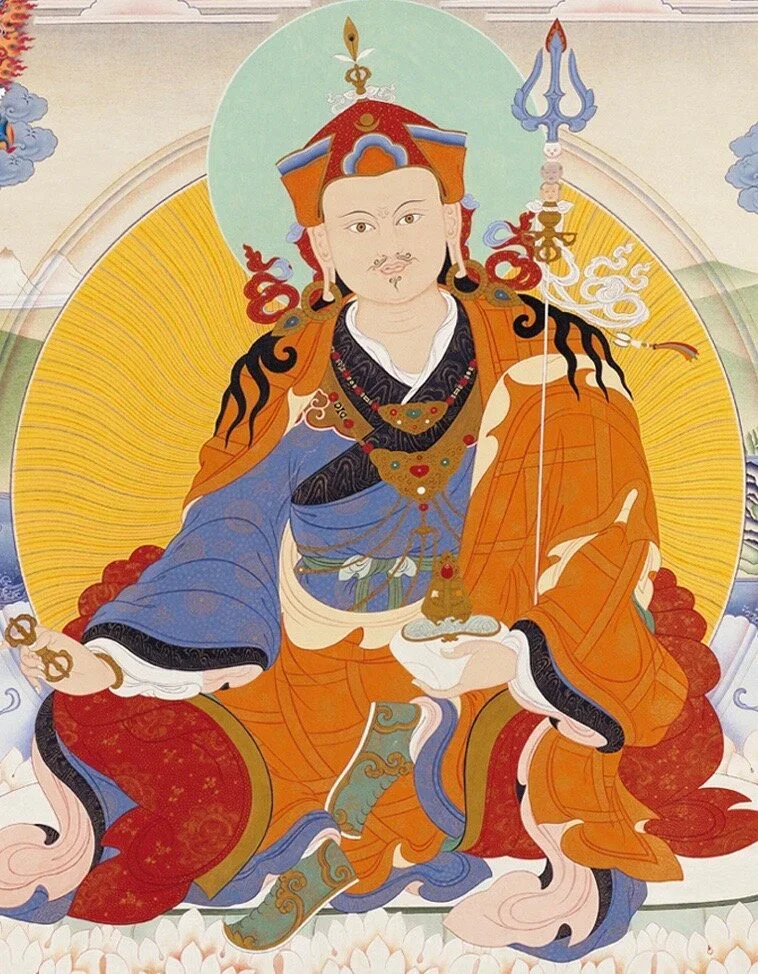
The teachings of Guru Padmasambhava serve as the basis for the philosophy of The Bhutan Baccalaureate. At the heart of Guru Padmasambhava’s teaching is the realization of primordial wisdom (yeshey – ཡེ་ཤེས), which is understood as the recognition of one’s innate awakened state. Similarly, The Bhutan Baccalaureate sees as its mission the harnessing or awakening of the primordial wisdom of every learner. An important feature of Padmasambhava’s teachings is the practice of unearthing treasures (Terma – གཏེར་མ) by treasure-discoverers (Terton – གཏེར་སྟོན). The Bhutan Baccalaureate similarly seeks to enable learners to become their own treasure-discoverers and unearth within themselves the various treasures that form a part of their innate being, their primordial wisdom. The Bhutan Baccalaureate believes that education is not just about learning but more importantly about helping a learner develop and recognize the Skills, Processes, and Watermarks that are necessary for self-actualization.
Drawing inspiration from Guru Padmasambhava’s approach, the Bhutan Baccalaureate Learning Process emphasises contextualisation rather than replacement. Like the way Guru Padmasambhava integrated diverse systems of knowledge while preserving the essence of his own teachings, the Learning Process views all cultural and natural environments as enabling environments for learning. The Learning Process draws from the strengths of the specific contexts, circumstances, and communities where learning takes place.
BHUTAN BACCALAUREATE LEARNING PROCESS
The Bhutan Baccalaureate Learning Process aims to develop Persons of Substance who appreciate and value their cultural roots while adapting to a changing world. The Learning Process assumes every human being has the power of intelligence and emphasises the role of education in augmenting this intelligence. It does not focus on simply imparting knowledge or students acing examinations but on building life skills and understanding processes of learning. It helps students to become self-directed learners, able to draw on a wide variety of resources, both traditional and emerging. With the assumption that everyone possesses a natural sense of curiosity and unique abilities, it helps students to engage thoughtfully with the world around them.
The Bhutan Baccalaureate Learning Process emphasises helping learners become self-directed learners. Becoming a self-directed learner will enable learners to constantly adapt and evolve, thereby actualising their dynamic innate potential. During this process, every individual takes a unique path, follows a suitable pace and sets their own standards to learn and grow in each of the Five Areas of Development.
To learn more about the Bhutan Baccalaureate Learning Process, click the button below.
-
The Bhutan Baccalaureate Curriculum is grounded on six development stages of learners that range from 2 to 17 years. Each stage focuses on a set of Skills, Processes, and Watermarks in five development areas through the rigorous learning process and assessment practices in seven domains. The Domains are English, Dzongkha, Mathematics, Aesthetics & Technology, Sports, and Life Science. The BB Curriculum also consists of courses authorized by AP College Board.
To enable the leaders of tomorrow to embrace opportunities, educational systems need to be ever-evolving, constantly adapting not only to the needs of the present, but also those of an anticipated future. In this light, the Bhutan Baccalaureate curriculum strives to remain futuristic and ever evolving with opportunities for contextualisation at local and national levels, allowing individuals to actualise their potential in becoming a constructive contributory citizen in creating a just and harmonious society.
-
The Five Areas of Development in the Bhutan Baccalaureate are Social Area of Development, Emotional Area of Development, Spiritual Area of Development, Physical Area of Development, and Cerebral Area of Development.
The Five Areas of Development are the lens through which the Learning Process views the wholistic growth of learners. These areas are not standalone, but deeply interconnected aspects of a learner’s growth. Recognising this, the Learning Process is designed to focus on all five areas simultaneously, ensuring that learners are supported in becoming well-rounded individuals capable of adapting to a rapidly changing world.
The Bhutan Baccalaureate’s Five Areas of Development has also been selected by HundrED’s (in Finland) top 100 education innovations since 2018. Click here to view HundrED’s page on the Bhutan Baccalaureate’s Five Areas of Development. -
Assessment and Reporting in the Bhutan Baccalaureate is the engine that drives the Learning Process. It aims to help learners develop Skills, Processes and Watermarks, and grow in the Five Areas of Development. Assessment is a means to enable and nurture wholistic development of Learners. It should help Learners view and understand their Learning journey – the particular areas of improvement and more importantly, the patterns and relationship of their growth.
This analysis of their learning journey is both qualitative and quantitative in nature, through the use and emphasis of Roadmaps, reflection, reviews, and effective feedback. Assessment is a continuous and evolving process, which intends to strengthen and enable a learner’s understanding of themselves. It encourages Learners to constantly be in the learning mode, to recognize and identify their internal resources and areas they want to develop further.
-
Cross pollination is a process that cuts across all the Seven Domains and the Five Areas of Development. Through this process we should be able to zoom out to see the larger picture and zoom in to see the cellular image. The lens through which we view the world can colour our decisions and affect our choices. Some people prefer to see things up close, others from afar. It is crucially important to know when to zoom in and when to take the bird’s eye view. However, most education systems follow the one-size-fits- all approach and thrusts one idea for all children. In the Bhutan Baccalaureate, Cross Pollination allows for learners to explore the missing link between the domains that has been created by our present educational system.
Rooted in the interconnectedness of our world, the non-silo approach of Cross Pollination forms the basis of all learning in the Bhutan Baccalaureate. Through Cross Pollination, learners connect their experiences, abilities, and knowledge using different Skills, Processes, and Watermarks. It enables learners to constantly challenge themselves to raise their bar to meet the expectations of the changing world. What is true today may not be true tomorrow. The nature and dynamics of change evolves over time.
-
Skills are the capabilities or mechanisms used by learners to learn, interpret, analyse, and synthesise both existing knowledge and new knowledge. Skills are functional, oriented toward a result, and are often embedded and interlinked. Some examples of Skills include critical thinking, collaboration, and decision making.
Processes are the means by which learners acquire skills and knowledge. Processes help the learner make connections with existing knowledge and experiences and create new knowledge. Processes also help the learner apply and transact this knowledge with others in the community. Some examples of Processes include reflection, exploration, and collaboration.
Watermarks are the inner qualities, character and personality traits, and attitudes that manifest in a learner in specific situations or conditions. The development of these Watermarks is not left to chance or as a positive side effect of the Learning Process. Learners are aware of the Watermarks they want to develop, and intentionally incorporate them into their aspirations and expectations from the Learning Process. Some examples of Watermarks include rigour, self-awareness, and resilience.
-
The meaning of Aesthetics extends far beyond the appreciation of beauty; it embodies a deep awareness of our interconnectedness with the universe and our role within it. This understanding enables learners to be actively involved in shaping their interactions with the world around them. This outlook encourages a way of life that emphasises collective well-being rather than individual success.
At the same time, Technology has transformed human existence, reshaping how we carry out daily activities and broadening our understanding of the world. Recognising this impact, the Learning Process integrates technology not merely as a tool for learning, but as an essential element in nurturing the wholistic growth of learners. Technology connects learners to resources and global contexts beyond the physical boundaries of their schools. Yet, in a world that is deeply connected by technology, learners need to develop skills that enable them to use technology to augment their intelligence instead of outsourcing their work to technology. This is where the mindset of Aesthetics becomes important. An Aesthetic Mindset is the source of discernment and ethical awareness—qualities that help learners engage with technology in meaningful and responsible ways.
-
Human beings are a part of nature and possess a fundamental connection to it. Every philosopher who has walked this earth has written volumes about their experiences in engaging with Nature, including their own place in nature as living and thinking beings. The Bhutan Baccalaureate sees Nature and its processes as vital guides for the development of our inner and outer selves. Every human being enters life with a fundamental and innate nature which is pure, joyful, wholesome, creative, and ever-evolving. Such a primordial state is inherently consistent with the processes of the natural world. By recognising our inherent connection and indivisibility with Nature, humans can begin to perceive the natural world as a mirror reflecting their own nature and processes. Such a recognition entails the perception of nature and its functioning as the medium through which individuals learn to learn about themselves, and hence forms a model for human evolution. As such, living in coherence rather than competing with Nature is what the Bhutan Baccalaureate is striving to achieve. By studying Nature, its patterns and its processes, we can learn to synchronise the outer world and our inner world in such a way that we articulate Nature and our dispositions simultaneously and harmoniously, developing genuine appreciation towards the natural wonders around and within as a Watermark through the course of one’s life.
-
Every individual is part of a larger community. The Bhutan Baccalaureate recognises that the wholistic development of individuals cannot be possible if we separate the individual’s aspirations from that of the community’s. In the Bhutan Baccalaureate, the term ‘community’ is not limited to the individual home or school community that the learner comes from but expands beyond this to encompass all communities that a learner engages and learns with. The Bhutan Baccalaureate’s community-centred approach therefore embeds the learner within their local and global contexts to foster exploration of integral, mutualistic relationships between learners and their communities, ensuring that learning is a dynamic and collective process.
Bhutan Baccalaureate Transition
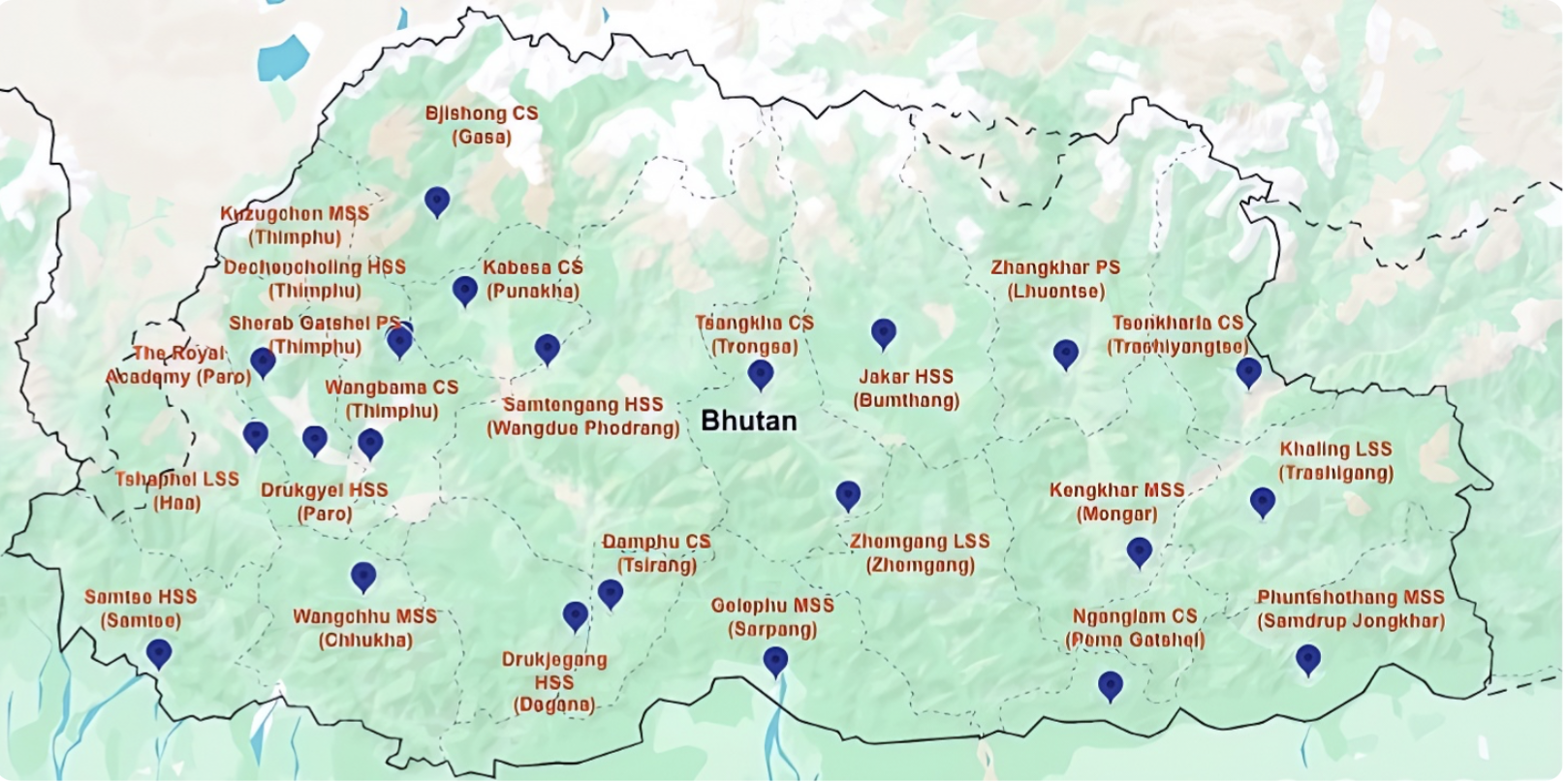
His Majesty The Druk Gyalpo granted a Royal Kasho on 17 December 2020 to initiate a transformative reconceptualisation of the education system and aim for educational standards and goals which are of the highest possible order. In line with the Royal Kasho on Education Reform, the Department of School Education, MoESD decided to adopt and implement the Bhutan Baccalaureate in 22 schools (later 23, with the bifurcation of one school) as one of the approaches to school education reform. The signing of the Memorandum of Understanding between the Ministry of Education and Skills Development (MoESD) and Druk Gyalpo’s Institute was formalized in 2021.
To guide teachers and students in the contextualisation and implementation of the Learning Process in the transitioning schools, the faculty of the DGI committed to an involvement of a minimum of three years. The first year was spent on building an understanding of the philosophy of the Bhutan Baccalaureate, the second on instituting the learning process and contextualising it to the school and the third year involved taking the Bhutan Baccalaureate to the lives of the students. A mentorship system was established, where each of the 23 schools was assigned a dedicated mentor to support their smooth transition to the Bhutan Baccalaureate. The transition has impacted approximately 1,100 teachers and 11,000 students across the now 23 Bhutan Baccalaureate schools.
While the transition process has come to an end, the engagement among the BB schools only continues to grow. The Druk Gyalpo’s Institute remains actively involved, offering leadership and professional development programmes to support the ongoing growth of the Bhutan Baccalaureate schools as a connected and evolving learning community.